Quick definition
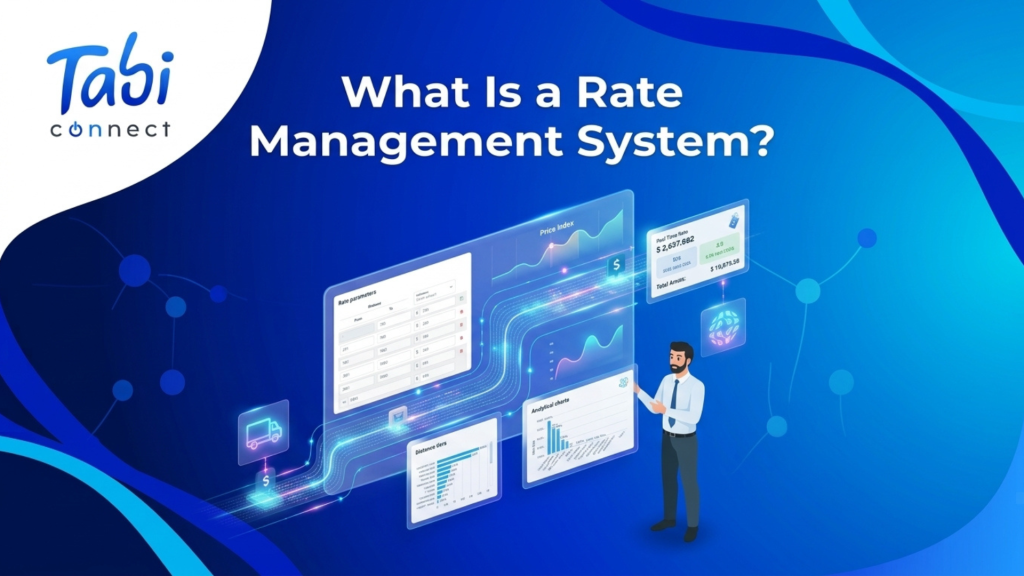
A Rate Management System (RMS) is software that automates freight quoting and turns every request into pricing data brokers can act on. It captures rate requests from shipper platforms, bid boards, and email, prices each one using rules the broker defines, and submits the quote back to the shipper, in some cases in as little as two seconds, without a rep manually handling the request. Every request is captured in full, whether it turns into a submitted quote, gets routed for manual review, or falls outside what the broker wants to quote at all. When a load is awarded, that outcome is tracked against the original quote too, so brokers can see quoted markup next to what was actually awarded. The result is a complete record of what got quoted, what got skipped, and what won, instead of a summary limited to the loads that closed.
Freight brokers use the term in a few different ways, so it helps to be precise. An RMS is not a rate lookup tool, and it is not a transportation management system. It is the layer that sits between the two, turning a rate request into a submitted quote without a person doing the mechanical steps by hand.
The rest of this page covers what an RMS actually does, why it exists as a separate system from a TMS, how brokerages use quoting data as a pricing strategy instead of a reporting exercise, and what to look for if you are evaluating one.
An RMS is built around five core functions. Together they cover the full quoting cycle from the moment a request arrives to the moment a win or loss is recorded.
Multi channel request capture
Connects to shipper TMS platforms, bid boards, and email using API where available and RPA where it is not, so requests from every channel land in one place.
Configurable pricing logic
Markup rules, lane specific adjustments, and customer tiers are set through a browser interface and applied the same way on every quote, with no coding involved. Pricing logic doesn’t have to be built as traditional if/then statements either. AI pricing rules let brokers set quoting logic in plain language, and those rules stack on top of the rest of the pricing setup instead of replacing it. That means a broker can adapt to a quick change in a lane without having to go in and manage how each individual rule operates.
Automated quote submission
Quotes go back to the shipper directly, without a rep in the loop for requests that fall within the defined pricing rules.
Control Tower and exception routing
Not every request should go out automatically, and Control Tower is where a broker decides that. It routes quotes to a human review queue whenever a broker wants a person in the loop, whether that’s a specific shipper, a complex lane, or any request that falls outside the defined pricing parameters. It’s optional and configurable per lane or account, so brokers can let the rules run on what they trust and keep manual review on the parts of the book where they still want a person checking the quote before it goes out.
Quoting analytics
Every request is logged whether it resulted in a quote or not, giving operations a complete view of response rate, win rate, and quoted markup by lane. Instead of building a report to find out why win rate dropped on a lane, operations can ask the system directly and get an answer from the underlying quoting data, without pulling it manually.
The short answer is that a TMS and an RMS are built to solve different problems, not the same problem at different price points.
A TMS is architected around the lifecycle of a load that already exists. Once a load is awarded, it moves through tendering, tracking, documentation, and invoicing, each stage anchored to a single record. That’s a sequential, one-record-at-a-time workflow, and TMS platforms are built well for it.
Quoting is a different kind of problem. A brokerage fielding requests across shipper platforms, bid boards, and email is handling high volume, sub-second response expectations, and parallel requests where most never turn into a load at all. That’s not a lifecycle problem, it’s a throughput problem. Building real automation for that means the system has to be architected for volume and speed from the start, not added as a module on top of software designed to manage one load through its stages.
That’s why most TMS quoting modules stay at basic rate lookup. It’s not a feature gap that will close with the next release, it’s a mismatch between what the system was built to do and what quoting actually requires. A rate management system is purpose-built for the quoting side, and it connects to the TMS once a quote is awarded and becomes a load.
Most brokerages still price off rep memory and experience. A rep knows a lane, has a feel for what it’s trading at, and quotes off that instinct under time pressure. That works until it doesn’t scale: it doesn’t transfer when a rep leaves, it’s inconsistent across a team, and there’s no way to see whether the brokerage is systematically over or under quoted markup on specific lanes versus the market.
An RMS changes what’s possible here because every quote becomes a structured data point instead of a decision that lived in someone’s head. Response rate, win rate, and quoted markup by lane turn pricing into something a brokerage can actually manage and improve, rather than something that depends on who happens to be working a given lane that day. Brokerages that treat their quoting data this way are working from a real pricing strategy. Brokerages still quoting off memory are competing on instinct, and instinct doesn’t hold up as request volume grows.
The most common confusion is between an RMS and a TMS, since most TMS platforms include some quoting functionality. The table below shows where each approach holds up and where it does not.
| Function | Manual Quoting | TMS Quoting Module | Rate Management System |
| Response time | Response time varies widely by rep and by how many requests are queued | Built for occasional use, not timed for spot response | As little as 2 seconds |
| Channel coverage | Limited to channels a rep actively checks | Rate lookup within the TMS interface only | Shipper platforms, bid boards, and email simultaneously |
| Pricing logic | Applied inconsistently depending on the rep and time pressure | Basic rate lookup, no configurable markup rules | Broker defined logic, applied the same way every time |
| Visibility | No structured record of missed or lost requests | Reporting limited to loads that were booked | Captures every request, quote, win, and loss |
| Scalability | Capped by headcount | Not built for high daily request volume | Processes requests simultaneously regardless of volume |
The other point of confusion is with rate intelligence subscriptions like DAT RateView, Sonar, Truckstop RateCast, and C4 Connections. Those tools provide market rate data. They tell you what a lane is trading at. They do not capture requests, apply your markup rules, or submit a quote. An RMS connects to those subscriptions through API and uses the data they provide as one input in a quote it builds and sends automatically. Brokers keep their existing rate intelligence relationships and add the RMS as the automation layer on top.
RMS platforms are built for freight brokerages and 3PLs that receive spot quote requests across multiple shipper platforms. The point at which a brokerage typically starts evaluating one is when manual quoting is visibly constraining how many requests get answered, or when response time is costing loads that were priced correctly but arrived too late.
| A note on where this definition comes from Tabi Connect’s pricing logic was designed by Joel McGinley, co-creator of DAT RateView, one of the freight industry’s primary rate benchmarking tools. That background shapes how this page defines the category, from the pricing and data side of freight, not just the software side. |
What does RMS stand for in freight?
RMS stands for rate management system. In freight brokerage, it refers to software that automates the process of receiving a rate request, pricing it according to broker defined logic, submitting the quote back to the shipper, and logging the outcome so the brokerage has structured data on response rate, win rate, and quoted markup.
Is a rate management system the same as a TMS?
No. A TMS manages a load after it has been awarded, covering carrier tendering, tracking, documentation, and invoicing. A rate management system operates before the award, handling the quoting workflow. The two are built on different architectures because they solve different problems, sequential load management versus high-volume, parallel request handling. Most brokerages run both, and they connect to each other.
Is a rate management system the same as a rate intelligence tool like DAT RateView?
No. A rate intelligence tool provides market rate data that a person or system references when pricing a load. A rate management system pulls from those rate sources automatically and uses them to build and submit a quote. Brokers keep their rate intelligence subscriptions and add an RMS on top.
Do freight brokers need a rate management system?
Brokers handling a low volume of quote requests can often manage manually. Once a team is fielding dozens of requests a day across several shipper platforms, response time and consistency typically start to suffer, which is the point at which an RMS addresses a measurable operational gap.
How does a rate management system work?
An RMS connects to shipper platforms, bid boards, and email through API and RPA to capture rate requests as they arrive. It applies the broker’s pricing logic automatically, pulls current market rates from the broker’s existing rate sources, and submits the quote, in some cases in as little as two seconds, without a rep in the loop for routine requests.
What features should a rate management system have?
At minimum, an RMS should offer multi channel request capture, configurable pricing logic with no coding required, automated quote submission, exception routing for requests outside defined parameters, and analytics that capture every request whether or not it resulted in a quote.
Tabi Connect is a rate management system built for freight brokers. It connects to 70+ shipper platforms, applies your pricing logic automatically, and submits quotes in as little as 2 seconds.
Book a Demo now!
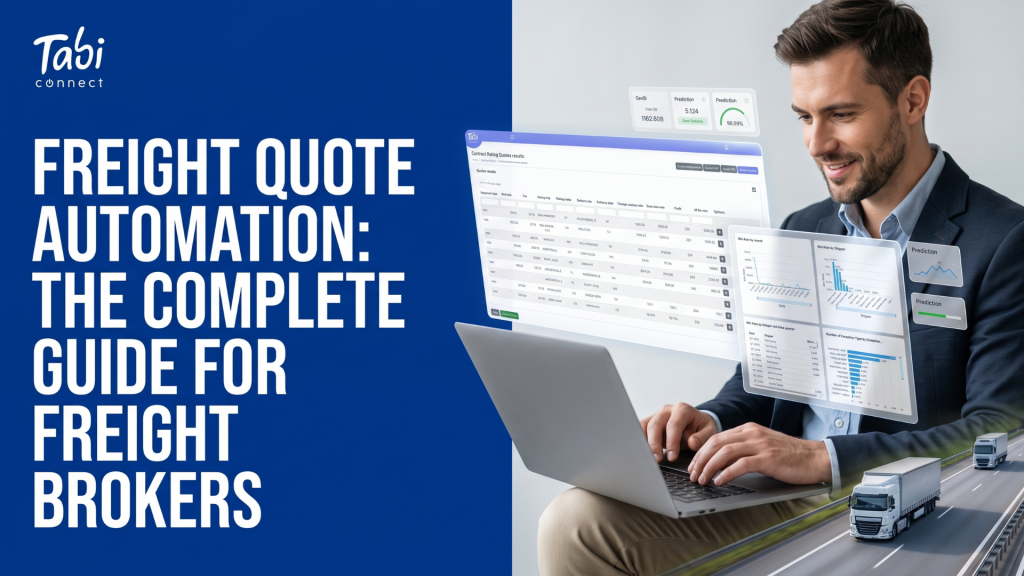
Freight quote automation is the use of software, API connections, and rules-based pricing logic to generate and send a freight rate without a person manually pulling data, doing the math, and typing a response. Instead of a rep opening a TMS portal, checking a rate tool, calculating markup, and typing an email, the system does it in seconds and logs the result automatically.
For brokers, that shift matters more than it did even two years ago. Rate requests now arrive from a shipper’s TMS portal, a bid board, an inbox, and a phone call, often within the same hour, and shippers are rewarding whoever answers first. This guide walks through what freight quote automation actually is, how it works under the hood, what it takes to evaluate a platform, and how to roll one out without losing your team’s trust in the process.
Freight quote automation is technology that captures a rate request, pulls the data needed to price it, applies a brokerage’s own pricing rules, and returns a quote, without a person doing each of those steps by hand. The request might come from a shipper’s TMS, a load board, an email, or an internal rep typing a quick lookup. The output is the same either way: a rate, a markup calculation, and a record of the transaction.
This is different from a rate lookup tool that just shows you a market number. Automated freight quoting closes the loop. It takes the market data, your cost basis, and your business rules, and produces a final number that goes out the door, whether that is to a shipper’s portal, an email reply, or a rep’s screen.
Three things distinguish real freight quote automation from a partial fix: it covers every channel, with email, TMS portals, bid boards, and internal requests all flowing through the same pricing logic instead of separate manual processes; it applies pricing rules consistently, so the same shipper gets the same treatment regardless of which rep or which channel handled the request; and it captures the data automatically, so every quote, win, and loss lands in a reporting layer without someone re-entering it.
Spot and contract rates have been moving closer together, which changes how brokers compete. In the U.S. Bank and DAT Freight & Analytics Q1 2026 rate report, spot rates closed at $1.65 per mile by the end of November 2025 while contract rates held at $2.02 per mile, a narrower gap than brokers saw earlier in the freight downturn (FreightWaves, January 2026). When contract and spot rates sit closer together, shippers have more reason to shop the spot market, and brokers who respond slowly lose that business to whoever answers first.
Spot capacity is also swinging harder than it has in years. DAT’s load-to-truck ratio hit 9.9-to-1 for the week ending December 6, 2025, the highest point of the current downturn, according to data C.H. Robinson cited from DAT (Heavy Duty Trucking, December 2025). Ratios like that can flip in a matter of weeks. A brokerage that prices manually cannot reprice its entire book that fast. An automated pricing engine can, because the rules update once and apply everywhere immediately.
Response speed is not unique to freight. A widely cited 2011 Harvard Business Review study of more than 2,200 companies found that firms who contacted a web-generated sales lead within an hour were about 7 times more likely to qualify that lead than firms that waited even 60 minutes, and the average company took 42 hours to respond at all (Oldroyd, McElheran, and Elkington, Harvard Business Review, 2011). That research is not freight-specific, but the underlying dynamic holds in freight quoting too: the shipper who gets a fast, accurate answer tends to book with whoever answered first, not whoever eventually sent the best number.
Automated quoting is built around four layers that work together: capture, pricing, delivery, and reporting.
Capture is how the request reaches the system, whether that’s an email landing in a shared inbox, a bid posted to a shipper’s TMS portal, a form submission on a self-service rate page, or a rep typing load details into an internal tool. A real automation platform needs to capture all of these, not just one.
Pricing is where the rate gets built. The system pulls a baseline truck cost from market data, applies the brokerage’s markup rules, layers in accessorials, and produces a final number. This is the layer that used to live entirely in a rep’s head, built from experience and gut feel about a lane.
Delivery is how the quote goes back out. For a TMS portal or bid board, that means submitting the bid directly. For an email request, that means drafting and sending a reply. For an internal rep, that means displaying the number on screen so they can relay it by phone.
Reporting captures what happened: the rate quoted, whether it won, and the markup on the load. Without this layer, a brokerage has no way to see which lanes are winning, which reps are quoting the most, or where pricing needs to change.
A few components make up a complete quoting stack, and skipping one of them usually means falling back to manual work for that piece.
Rate data connections. The system needs a live feed of market rates to build an accurate baseline. That typically means API connections to sources like DAT, Greenscreens, Truckstop, or a brokerage’s own historical rate data. Tabi Connect’s DAT RateView and RateCast integration is one example of what that connection looks like in practice: real-time market data flowing directly into the pricing engine instead of a rep tabbing between browser windows.
A pricing logic engine. This is the rules layer: markup targets by lane or shipper, equipment-specific adjustments, accessorial handling, and exception thresholds. The best implementations let a non-technical ops or pricing lead configure these rules directly, without submitting an IT ticket every time a shipper’s terms change.
Channel coverage. The stack needs to reach every place a quote request shows up, which usually means email, shipper TMS portals, load and bid boards, and an internal tool for reps fielding phone calls. Tabi Connect’s platform breaks this out into separate modules: one for inbox-based requests, one for TMS and bid board connections, and one for internal rep lookups, all governed by the same pricing rules.
Analytics and reporting. Every quote, win, loss, and exception needs to land somewhere a pricing lead can actually use it. That is what turns automation from a time-saver into a strategy tool: you can see which lanes are winning, where markup is tightest, and which channels are underperforming.
Most freight quote automation relies on one of two connection methods to reach a shipper’s system, and most brokerages end up needing both.
API connections talk directly to a shipper’s platform on the back end. They are fast, typically returning a rate in about 3 seconds, and they do not break when a shipper redesigns their portal, because the connection happens below the visible interface. The tradeoff is that an API only exists where a shipper has built one, and setup can take 1 to 2 weeks per connection.
RPA (robotic process automation) connections work by mimicking what a person would do on screen: logging in, entering load details, and submitting a bid, the same way a rep would. RPA is slower, roughly 35 to 50 seconds per quote, and requires more upkeep, since a portal redesign can break the automation until it’s rebuilt. But RPA covers shipper platforms that do not have an API available, which in practice is most of them.
Electronic Data Interchange (EDI) is a third, older option still used in some legacy freight tech stacks. It works, but it is expensive to maintain and slow to adapt to new requirements, which is why most modern quoting platforms lean on a mix of API and RPA instead. For a deeper look at how the three compare, see this breakdown of RPA, API, and EDI in logistics.
The practical takeaway: a brokerage quoting across 60 or more shipper platforms will have some API connections and a larger number of RPA connections, because API coverage still lags shipper adoption. A platform that only supports one connection type will always have gaps.
Freight quote automation shows up in a handful of recurring scenarios inside a brokerage:
Inbox-based quoting. A shipper emails a rate request with load details in the body of the message. Automation extracts the origin, destination, equipment type, and dates, prices the load, and drafts a response, often in under 10 seconds, without a rep opening a second tab.
TMS and bid board bidding. Shippers post loads to their own TMS or a public bid board. Automation logs in (via API or RPA), reads the load details, applies pricing rules, and submits a bid, around the clock, including outside business hours when a rep would not otherwise be watching.
Internal quick-quote lookups. A customer calls and asks for a rate on the spot. Instead of the rep pulling up multiple tools, an internal quoting tool returns a full rate breakdown, baseline cost, market rate, and markup, in a couple of seconds.
Shipper self-service portals. Larger shippers get a branded rate window embedded on the brokerage’s site or sent as a link. The shipper enters load details and gets an instant rate without an email chain.
Rebidding on closed opportunities. Some bid boards let a broker see and adjust an offer even after a shipper has closed the bidding round to new entrants. One Tabi Connect customer using this kind of rebid functionality went from winning 5 of 929 submitted offers to winning 76 of 561, a roughly 15x increase in win rate, after automating that follow-up bidding process.
Bulk and RFP quoting. When a shipper sends a spreadsheet of hundreds of lanes for a bid package, automation applies the same pricing logic across every line at once instead of a team working through it lane by lane.
Manual quoting doesn’t erode margin through one bad pricing call. It erodes it through inconsistent quoted markup, repeated across the business in smaller ways than any single decision would suggest, which is exactly the argument laid out in Tabi Connect’s own margin protection guide for freight brokers. A few of the most common leaks: freight that never gets quoted because there isn’t time to get to it, markup that varies by which rep handles the request instead of a consistent strategy, quotes that go out late in the cycle and end up competing on price instead of speed or service, accessorials and edge cases applied inconsistently across hundreds of quotes, and no single view of what was quoted, won, or lost across every channel.
Automation does not remove judgment from pricing. It removes the variability that comes from doing the same process by hand, at different speeds, with different assumptions, every time.
Not every automation vendor covers the same ground. A few questions are worth asking before signing anything:
How many shipper platforms does it actually connect to, and through what method? Ask specifically about the mix of API versus RPA connections, since that tells you both coverage and long-term maintenance burden.
Where do the rates come from? A platform should support your existing rate subscriptions (DAT, Greenscreens, Truckstop, and similar) plus your own historical data, not force you onto a single proprietary data source.
Does changing pricing logic require code or an IT ticket? If a pricing lead cannot update a markup rule from a browser without involving a developer, that rule change will take days instead of minutes.
What does implementation actually require from your team? Ask about IT lift specifically. A well-built platform should handle its own infrastructure and API build-out rather than asking your internal team to manage servers or connections.
Is there a pilot option? A 30-day pilot with no long-term contract is a reasonable ask, and it’s a fair way to validate a platform against your actual shipper mix before committing.
How does pricing scale? Per-shipper pricing lets a brokerage add automation gradually instead of paying for capacity it does not need yet.
These evaluation questions matter more than any single feature, because the gap between vendors usually shows up in how they handle these operational details, not in the marketing copy. If you’re building this into a wider plan, it’s worth pairing this evaluation with a broader freight brokerage strategy, so pricing automation supports the goals you’ve already set rather than becoming a separate initiative.
The biggest risk in a quoting automation rollout is not the technology. It’s adoption. A system that reps do not trust gets worked around, and a system imposed from the top without input tends to face quiet resistance long after go-live.
A few things make rollout go more smoothly: give reps visibility into how a quote was built, since if a rep cannot see the baseline cost, the market rate, and the markup behind a number, they will not trust it and will default back to their own manual process. Bring reps in early, not after the decision is made, since teams that had a hand in shaping how pricing rules got set up tend to adopt the system faster than teams who had it handed to them. Start with the channel causing the most pain, since most brokerages get the fastest win by automating whichever channel is generating the most manual volume right now, usually email or TMS portal bidding, rather than trying to launch every module at once. And track more than time saved: the real return shows up in quote coverage, meaning how much available freight actually gets quoted, consistency, meaning whether similar freight gets priced similarly across reps, and visibility, meaning whether leadership can see win rates and markup by lane. For more on building change management into a rollout, see this guide to successful automation.
Most implementations run 4 to 5 weeks from signed agreement to live, and a 30-day pilot is a reasonable way to test the process with your actual shipper mix before rolling it out brokerage-wide. You can find current Tabi Connect pricing and a look at customer case studies if you’re comparing options.
For terminology used throughout this guide (rate engines, pricing logic, spot rates, and more), the freight technology glossary has plain-language definitions for each term.
What is freight quote automation? Freight quote automation is software that captures a rate request from any channel (email, a shipper’s TMS, a bid board, or an internal tool), applies a brokerage’s pricing rules, and returns a quote without a person manually pulling rates and doing the math.
How fast can an automated freight quote be generated? It depends on the connection type. API-based quotes typically return in about 3 seconds. RPA-based quotes, used for platforms without an API, generally take 35 to 50 seconds. Internal quick-quote tools for reps fielding phone calls can return a full rate breakdown in about 2 seconds.
Does freight quote automation replace the need for pricing judgment? No. It applies a brokerage’s existing pricing rules consistently and quickly. Reps and pricing leads still set the strategy, markup targets, and exceptions; automation just removes the variability of applying those rules by hand across hundreds of quotes a day.
What’s the difference between API and RPA for freight quoting? API connections talk directly to a shipper’s backend system and are fast and stable, but only exist where the shipper has built one. RPA mimics a human clicking through a shipper’s portal, which covers more platforms but runs slower and needs more maintenance when a portal changes.
How long does it take to implement a freight quote automation platform? Most implementations take 4 to 5 weeks from signed agreement to go-live. Many vendors, including Tabi Connect, offer a 30-day pilot program to test the platform against your actual shipper mix before committing to a longer contract.
Can freight quote automation work with our existing rate subscriptions? Yes, in most cases. A well-built platform should connect to rate sources you already subscribe to, such as DAT, Greenscreens, Truckstop, or Sonar, rather than requiring you to replace them.
Will automating quotes require our IT team to build anything? It shouldn’t require much. Platforms built for freight brokerages typically handle their own infrastructure, virtual machines, and API connections, so the IT lift on your side stays minimal. Ask any vendor directly what their implementation actually requires from your team before signing.
Ready to see how automated quoting would work across your specific TMS and bid board connections? Book a demo with Tabi Connect to walk through your own lanes.
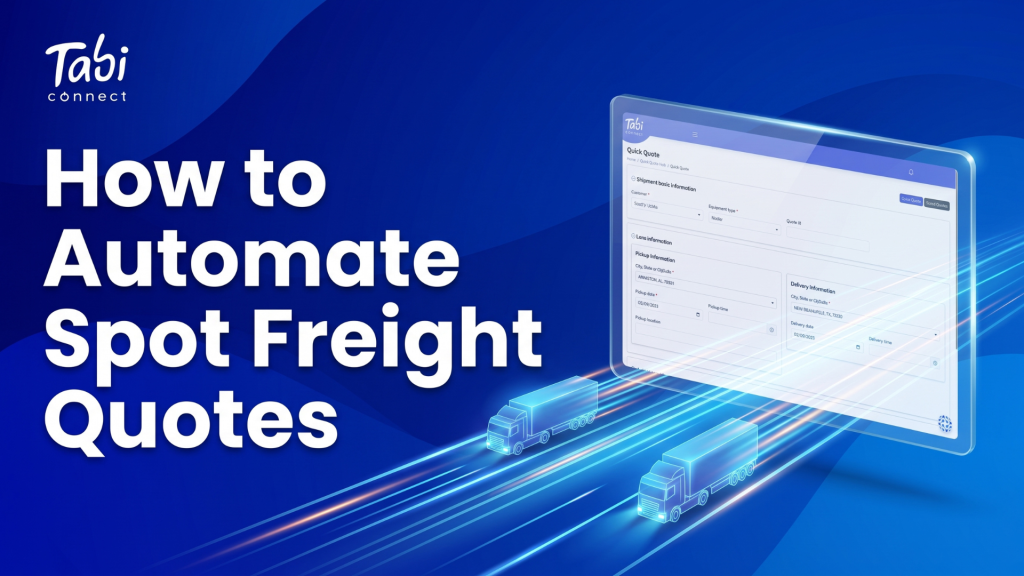
Spot quote automation is the use of software and API or RPA connections to price and submit a spot freight rate without a rep manually checking a rate tool, calculating markup, and typing a response. This guide is part of our broader freight quote automation guide; this piece focuses specifically on the spot market, where speed and volatility matter most.
Spot rates move fast, and manual quoting cannot keep pace with how fast. In the week ending December 6, 2025, DAT’s load-to-truck ratio hit 9.9-to-1, the highest point of the current freight downturn, according to data C.H. Robinson cited from DAT Freight & Analytics (Heavy Duty Trucking, December 2025). Ratios like that can shift within a matter of weeks, which means a pricing assumption that held up last month may already be wrong.
A manual process depends on a rep pulling a rate from a tool, doing the math on markup, and typing a response, all while the market underneath that quote keeps moving. By the time the quote goes out, it may already be priced against conditions that no longer apply. That’s before accounting for the requests that show up outside business hours, when no rep is watching the inbox or the bid board at all.
1. Connect your rate data. Spot pricing starts with a live market rate. That usually means an API connection to a source like DAT, Greenscreens, or Truckstop, feeding directly into your pricing tool instead of a rep tabbing between browser windows. Tabi Connect’s DAT RateView and RateCast integration is one example of what that live feed looks like in practice.
2. Build your pricing logic once. Set markup targets, equipment-specific adjustments, and accessorial rules in a single rules engine rather than leaving them in a rep’s head. The goal is that the same lane, quoted by any rep on any channel, gets priced the same way.
3. Cover every channel a spot request can land in. Spot requests show up in shipper TMS portals, public bid boards, email, and phone calls, often for the same lane within minutes of each other. Say a shipper posts a 53-foot dry van request from Columbus to Charlotte on their TMS portal at 2 p.m., emails the same broker a follow-up an hour later, and a different contact from the same company calls in asking for a rate on a similar lane the next morning. If only one of those channels is automated, the other two fall back to manual work, and the pricing a rep gives over the phone may not match what the system already quoted through the portal. Tabi Connect’s platform splits this into separate modules: TMSQuote for portal and bid board connections, EmailQuote for inbox requests, and QuickQuote for reps fielding a live phone call, all governed by the same pricing rules so the number stays consistent no matter which door the request came through.
4. Automate around the clock, not just during business hours. Spot requests do not stop at 5 p.m., and a meaningful share of bid activity happens overnight or on weekends when a manual team simply is not watching. Automated bidding covers that window without adding headcount.
5. Don’t stop at the first no. Some bid boards let a broker adjust an offer even after a shipper has closed the round to new bidders. This is where automation can compound: one Tabi Connect customer using this kind of rebid functionality went from winning 5 of 929 submitted offers to winning 76 of 561 after automating that follow-up bidding step, a roughly 15x increase in win rate.
6. Capture every quote in one place. Win, loss, and markup data should land automatically in a single reporting view. Without that, it’s difficult to tell which lanes are winning consistently and which ones need a pricing adjustment.
Spot quoting automation typically reaches shipper platforms through one of two connection types.
API connections talk directly to a shipper’s backend system. They’re fast, usually returning a rate in about 3 seconds, and they don’t break when a shipper redesigns their portal. The limitation is that an API only exists where a shipper has built one.
RPA connections work the way a person would: logging into the portal, entering load details, and submitting a bid. RPA is slower, typically 35 to 50 seconds per quote, and needs more upkeep since a portal change can break it until it’s rebuilt. But it covers shipper platforms that don’t offer an API, which in practice is most of them.
Most brokerages end up running both. For a fuller comparison, including where EDI still fits, see RPA, API, and EDI in logistics.
A few questions help separate a real spot quoting solution from a partial one: Does it connect to the rate sources you already subscribe to, rather than forcing you onto a proprietary feed? Can a pricing lead change markup rules from a browser without submitting an IT ticket? Does it cover TMS portals, bid boards, email, and internal rep lookups, or just one of those channels? Is there a pilot option so you can test it against your actual shipper mix before committing to a longer contract?
The gap between platforms usually shows up in these operational details rather than in a features list. If markup consistency across your quoting process is the bigger concern, Tabi Connect’s margin protection guide for freight brokers walks through where manual quoting typically leaks profit beyond just the spot market.
The shift is usually less dramatic on the surface than brokers expect and more noticeable in the numbers underneath. Reps stop opening four tools to answer one question, because the rate, the markup, and the recommended number show up in one place. Pricing stops varying by who happens to answer the phone, because the same rules apply whether the quote goes out by email, portal, or verbally on a call. And leadership gets a real answer to questions like how many of the available loads actually got quoted this week, instead of an estimate based on what a few reps remember.
None of that requires giving up judgment on individual loads. Reps and pricing leads still set the strategy. What changes is how consistently and how fast that strategy gets applied across every request that comes in, including the ones that show up at 11 p.m. on a Sunday when nobody is at a desk to answer them.
Ready to see how spot quote automation would run against your own shipper mix? Book a demo with Tabi Connect to walk through your specific TMS and bid board connections.