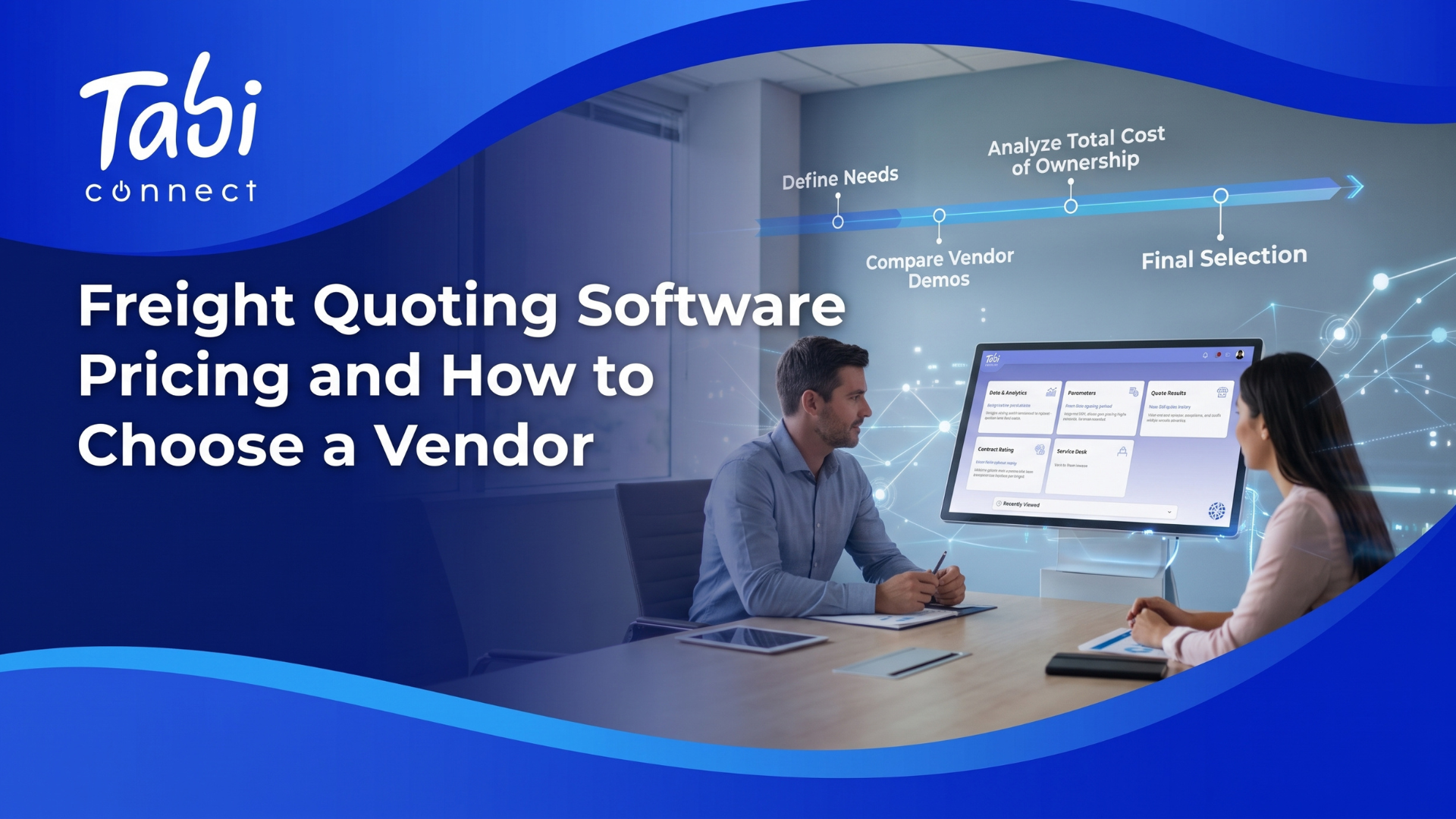
Freight quoting software pricing runs from a few hundred dollars a month for a handful of seats to five- and six-figure annual contracts once you add API-connected shippers, and the number that matters is not the sticker price, it’s the cost per quote at your actual volume once implementation, training, and the inevitable mid-contract tier upgrade are factored in. This guide covers the procurement side of the decision: what this software actually costs, the contract terms worth negotiating before you sign, and a scorecard for comparing vendors on the criteria that actually predict whether the tool gets used.
If you’re still evaluating what a rate management system is or how it differs from your TMS, see what a rate management system is and rate management system and a TMS for that foundation.
How Freight Quoting Software Is Actually Priced
Pricing in this category is almost never a flat per-user fee, because the cost to the vendor scales with quote volume and integration count, not seat count. The table below reflects the range this typically falls into, not any single vendor’s list price.
| Pricing factor | Lower cost | Higher cost |
| Shipper connections | A handful of shippers, mostly email-based | 40 or more shipper platforms, mostly API-connected |
| Quote volume | Dozens of quotes per day | Hundreds to thousands per day |
| Pricing logic complexity | Simple markup percentage, few exceptions | Lane-level rules, accessorial logic, 40+ parameters |
| Integration type | Standard API to a common TMS | Custom RPA builds for proprietary shipper portals |
| Analytics depth | Standard dashboards | Custom reporting, full funnel analytics |
Three cost components are easy to miss when comparing a sales quote against a budget line:
Implementation cost separate from the subscription fee. Some vendors bundle onboarding into the subscription. Others charge a one-time implementation fee that can run from a few thousand dollars for a standard integration to well into five figures for multiple custom RPA connections. Ask for this number in writing, separate from the recurring fee, before you compare pricing.
The tier upgrade you’ll likely need within a year. Most brokerages underestimate their quote volume growth when they first price out a system. If your shipper count or quote volume grows 30 to 50% in year one, which is common after quoting stops being a bottleneck, confirm what the next tier costs.
The cost of the integrations you don’t ask about upfront. A quote that looks 20% cheaper than a competitor’s can end up costing more once you add per-integration fees for shipper platforms that weren’t included in the base price.
What This Costs Over Three Years: A Worked Example
Sticker price comparisons fall apart over a multi-year contract, because the number that started the conversation isn’t the number you’re actually paying by year two. Here’s a directional example for a mid-size brokerage starting with 15 shipper connections and growing to 25 over three years, not a quote for any specific vendor.
| Year 1 | Year 2 | Year 3 | |
| Subscription tier | Entry tier, 15 shippers | Mid tier after growth past entry cap | Mid tier, stable |
| One-time implementation | Included in first-year cost | None (already implemented) | None |
| New integration builds | None beyond initial rollout | 2 to 3 new shipper connections | 1 to 2 new shipper connections |
| Renewal increase | N/A | Per contract’s annual increase clause | Per contract’s annual increase clause |
The pattern worth planning for: year one is usually the cheapest year you’ll have with this vendor, both because you’re on the entry tier and because you haven’t yet hit the growth that pushes you into the next pricing bracket. Budgeting as if year one’s cost is representative of years two and three is the single most common way this line item surprises a CFO. Tabi Connect’s pricing page shows what’s included at each tier as a starting reference point for building your own three-year model.
The Real Cost of Getting This Decision Wrong
Getting the vendor choice wrong doesn’t usually show up as a failed rollout. It shows up as a tool your team routes around. In G2’s 2026 Software Buying Trends Survey of 3,385 decision-makers, only one in three buyers reported successfully adopting new software without disruption or regret, and 61% had experienced implementation disruption in the prior 18 months (G2 Digital Markets, 2026).
That statistic isn’t specific to freight, but the mechanism is the same one that shows up in freight quoting rollouts: a system gets purchased against a features list, then the operational reality (a pricing exception the rules engine can’t handle, an integration that was “supported” but not actually tested against your TMS version) surfaces after the contract is signed, not before.
Due diligence aimed at the specific failure points below is what closes that gap, because that’s where it actually opens up.
What Actually Separates Vendors: AI-Assisted Pricing, Not Just Editable Rules
Most freight quoting software vendors will tell you their pricing logic is configurable. That’s table stakes, not a differentiator, and it undersells what’s actually possible in this category now. The more useful question is whether the platform helps a pricing lead find the right rule in the first place, or just gives them a form to type one into.
There’s a real difference between a rules engine that requires someone to already know the answer, and one that uses your own historical quote and win data to suggest where a markup target is too aggressive on a lane, where a lane is winning consistently and could bear a higher markup, or where an accessorial rule is triggering more exceptions than it should. Tabi Connect’s Control Tower is built around this: semi-automated quoting that surfaces a recommended number and lets a human approve it, rather than either forcing a rep to build the number from scratch or removing their judgment from the process entirely. The goal isn’t a system that replaces pricing decisions. It’s one that makes the person setting them faster and more consistently right, using data most brokerages already have but aren’t using.
When you’re evaluating vendors, ask this directly: does the platform only apply rules you write, or does it help you write better ones? A vendor that can’t answer beyond “you can edit the rules anytime” is describing a form, not a decision-support tool.
A Freight Quoting Software Vendor Evaluation Scorecard You Can Actually Use
Score each vendor 1 to 5 on each criterion, multiply by the weight, and total it. This turns “we liked the demo” into a comparison you can actually defend to whoever signs the check.
| Criterion | Weight | What a 5 looks like | What a 1 looks like |
| Live integration to your specific TMS and top 5 shippers | 20% | Tested, working connection demonstrated live | “We can build that” with no committed date |
| Omnichannel request coverage: email, shipper TMS, internal lookups | 15% | Every channel where a quote request lands runs through the same pricing logic | One channel automated, the rest still manual |
| Pricing logic your team can edit, and that helps you set it right | 20% | Browser-based rule changes, plus data-driven recommendations on markup targets | Every change requires a vendor support ticket, and the vendor has no view on whether the rule is good |
| Role-based access and governance | 10% | Granular control over who can view, edit, or approve pricing logic by role | One shared login, no distinction between a rep and a pricing lead |
| Reporting and actionable analytics | 15% | Full funnel: requests in, quoted, won, lost, by shipper, lane, and channel, with clear next-action signals | Win/loss totals only, no request-level data |
| Total cost at your actual volume, all-in | 10% | Written quote covering subscription, implementation, and next-tier cost | Verbal range with “it depends” on the details |
| Implementation timeline tied to your integration list | 5% | Dated project plan matched to your specific shippers and TMS | Generic “4 to 6 weeks” with no specifics |
| Reference customer at your size and complexity | 5% | Named reference willing to discuss rollout, not just results | Logo on a slide, no reference call offered |
A vendor that scores well on the demo but poorly on this scorecard is telling you something the demo won’t: that the gap between what they showed you and what you’ll actually get is wider than it looked in the room. This scorecard is deliberately weighted toward the criteria that determine whether the tool becomes a real decision-support layer for pricing, not just a faster way to send the same rules you already had. If you also want a feature-by-feature checklist for comparing platform capabilities directly, Tabi Connect’s evaluation checklist covers that ground in more detail.
Why Role-Based Access Matters More Than It Looks Like It Should
A pricing and markup strategy is only as protected as the system that enforces it. If every rep can edit a lane’s markup rule, or if there’s no record of who changed what and when, the pricing logic a brokerage spent weeks building starts drifting the first week reps have their hands on it.
Look for a system that lets you define who can view quoting activity, who can propose a rule change, and who has final approval on markup targets and exception thresholds, mapped to actual roles: rep, pricing lead, operations manager. This isn’t a compliance checkbox. It’s what keeps the pricing strategy a brokerage designed from quietly becoming whatever forty individual reps decided it should be.
Build vs. Buy: Why Most Brokerages Land on Buy
Building a pricing and quoting system internally comes up in almost every vendor evaluation, usually from whoever owns the engineering budget and wants to avoid a recurring software line item. It’s worth a real answer.
The case against building: quoting software isn’t a one-time build, it’s an ongoing maintenance commitment, since shipper platforms change their portals, market data sources update their APIs, and your own pricing logic will need to evolve as your business does. A vendor with dozens of customers running similar workflows has already solved the shipper integration problem you’d be solving from scratch, and their roadmap is funded by many customers’ worth of subscription revenue, not your engineering team’s spare capacity. Most brokerages that actually run the build-vs-buy math land on buy once they price in year two and three maintenance, not just the initial build.
The exception: a brokerage with a genuinely unusual pricing model that no vendor’s rules engine can accommodate, and enough engineering capacity to treat this as a real product, not a side project. That’s a narrow case. Most brokerages evaluating this decision are not in it.
Contract Terms Worth Negotiating Before You Sign
Termination and data portability. Confirm you can export your quoting history, pricing rules, and shipper connection configurations if you switch vendors later. A contract that locks your pricing logic inside a proprietary format you can’t export is a switching cost you’re agreeing to sight unseen.
What happens when a shipper platform changes. RPA integrations break when a shipper redesigns their portal. Ask who is responsible for rebuilding the connection, on what timeline, and whether that’s covered under your existing contract or billed as a change order.
Price protection on renewal. Multi-year software contracts commonly include an annual increase clause. Know the number before you sign, not when the renewal invoice arrives.
Minimum commitment versus actual usage. If the contract has a minimum shipper count or quote volume commitment, confirm it matches your realistic ramp-up, not the number the sales team used to get you into a better tier.
Who owns pricing logic changes after go-live, in writing. A verbal assurance that “you can update rules anytime” isn’t the same as a contract clause guaranteeing browser-based, no-ticket rule changes, tied to specific roles. If access control and rule ownership matter enough to weight on the scorecard above, they matter enough to get in writing.
Contract Length: Month-to-Month vs. Multi-Year
Vendors typically offer a discount for locking into a multi-year term, and whether that trade makes sense depends on how confident you are in the fit after your evaluation, not just the discount percentage.
A multi-year contract makes sense when you’ve run a real evaluation (the scorecard, the reference calls, a demo against your own quote data) and the vendor has already proven the integrations that matter most to you. Locking in a lower rate for two or three years is a reasonable trade once you’ve done that work.
A shorter initial term, even at a higher monthly rate, makes sense when a specific integration is unproven, when your shipper count or quote volume is likely to change significantly in the next year, or when the vendor pushed hard for a multi-year commitment before you’d finished your own evaluation. A vendor confident in their product should be comfortable earning a longer commitment after a shorter initial term proves out, rather than requiring the long term upfront.
Either way, tie the contract length to something you can verify, not just the discount offered. “We’ll sign a two-year term once our top 5 shippers are live and tested for 30 days” is a stronger negotiating position than agreeing to a multi-year term based on a sales demo alone, and it gives you a clean, contractually clear way to walk away if that 30-day test doesn’t hold up.
How Long This Should Actually Take
Rushing a decision and dragging one out both create real cost. Per G2’s 2026 research, buyers who successfully adopt new software typically narrow their search to three vendors and decide within three months (G2 Digital Markets, 2026). That’s a useful benchmark: if you’re still adding vendors to your list at week eight, the search has lost focus. If you’re being asked to sign within a week of a first demo, that’s a signal the vendor is selling faster than they can actually implement.
A reasonable timeline looks like: two to three weeks identifying and narrowing to three vendors, two to four weeks running structured demos against your own quote data (not vendor sample data), one to two weeks on the scorecard above and reference calls, and final contract negotiation before signature. Ten to twelve weeks total is realistic for a mid-size brokerage. Longer than that usually means the requirements weren’t clear at the start, not that the vendors are all equally hard to evaluate.
Frequently Asked Questions
- How much does freight quoting software typically cost?
It varies by shipper count, quote volume, and integration complexity more than by vendor brand. Get a written, all-in quote (subscription plus implementation plus likely next-tier cost) rather than comparing sticker prices, since two vendors’ base pricing can look similar while their all-in cost diverges sharply.
- Should we always pick the cheapest option that meets our feature list?
No. The scorecard weighting above puts the most weight on live integration, pricing logic quality, and reporting, not price, because those are what determine whether the tool actually gets used at the volume you bought it for.
- How many vendors should we evaluate?
Three is a reasonable number based on G2’s research on successful software adoption. Evaluating more than that tends to slow the decision without meaningfully improving it, since the differences between vendors five through eight are rarely decision-relevant.
- What’s the biggest red flag in a vendor’s contract?
No clear answer on who rebuilds a broken RPA integration and on what timeline. That gap turns into unplanned downtime on a shipper connection you’re depending on.
- Do we need a formal RFP for this, or can we just do demos?
If you’re comparing more than one vendor and the decision involves real budget, send the RFP questions above in writing first. It surfaces vague answers before you’ve invested time in demos that all vendors are equally good at running.
- Is it ever worth building this internally instead of buying?
Rarely, and only if your pricing model is genuinely unusual and you have engineering capacity to treat this as an ongoing product commitment, not a one-time project. Most brokerages that run the three-year cost comparison land on buy.
Ready to see a live quote against your own shipper list and pricing rules instead of a sample dataset? Book a demo with a Tabi Connect Rate Tech Expert and bring your RFP questions with you.