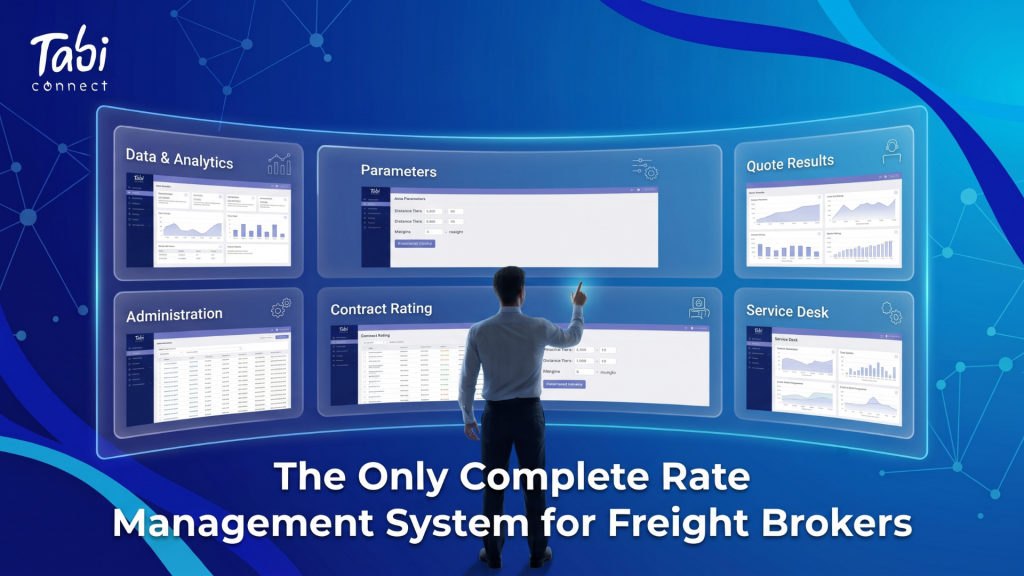
If your freight brokerage is evaluating a rate management system or quoting automation platform, most tools will look similar on the surface. The difference shows up after implementation, when the tool meets your actual workflow.
Evaluating what matters in a real brokerage environment — not in a demo
Most tools will look identical during sales pitches: they all show rates, talk about automation, and claim to improve speed. This roadmap is designed to help operations leaders identify structural strengths from generic features before launching implementation.
1
Can it quote where your requests actually show up?
Freight does not come through one channel. Your team is working across shipper TMS platforms, shipper portals, bid boards, and email. If your system only covers part of that, your process is still fragmented.
WHAT TO LOOK FOR
- Quoting directly inside email workflows, not forcing reps into a separate tool.
- Coverage across shipper TMS platforms and shipper portals.
- Bid board quoting, not just internal rate generation.
- A single workflow across channels, not separate logins and processes.
WHAT TO WATCH FOR
Many tools stop at “rate generation.” They give you a number, then expect your team to apply quoted markup and submit manually. That is not quoting automation. That is a pricing tool with extra steps.
| WHY IT MATTERS If your team is still stitching together the workflow across channels, you will continue to miss volume, slow down response time, and introduce inconsistency. |
2
Does it integrate in the way your customers operate?
Integration is one of the most overused words in this category. The real question is whether the system can connect to the platforms your customers use, even when those platforms are inconsistent or lack APIs.
WHAT TO LOOK FOR
- API connections when available.
- RPA coverage when APIs are not available.
- No requirement to purchase additional APIs just to make the system work.
- Pre-built connections that reduce setup time.
WHAT TO ASK
- Is this integration API, RPA, or both?
- What happens when a shipper platform does not support APIs?
- Can we run a pilot across our actual shipper mix?
- How does this work alongside our TMS?
| WHY IT MATTERS API-only solutions work in clean environments. Most brokerages do not operate in clean environments. If your system cannot handle both, automation will break across part of your network. |
3
Can your team control pricing logic without engineering?
Speed without control creates risk, and control without speed creates bottlenecks. The systems that hold up over time give business users direct control over pricing logic.
WHAT TO LOOK FOR
- No-code pricing logic that can be configured by shipper, lane, region, and equipment.
- The ability to adjust quoted markup targets, rules, and parameters without developer support.
- Real-time updates, not delayed release cycles.
- Plain-language rule creation, with AI assistance for setup and review.
WHAT TO WATCH FOR
Many tools describe logic as simple if-then rules or static fields. That works for basic scenarios, but breaks under real-world complexity.
| WHY IT MATTERS If pricing logic cannot evolve quickly, your team will fall back to manual overrides. That is where consistency and markup control start to break down. |
4
Does it have governance built in, not added on?
As soon as you give teams the ability to move faster, you need guardrails. Without them, one bad change can impact an entire book of business.
WHAT TO LOOK FOR
- Role-based permissions for who can create and edit pricing rules.
- Full audit history showing who changed what, and when.
- Version control or rollback capability.
- The ability to pause or adjust rules in real time.
WHAT THIS LOOKS LIKE IN PRACTICE
In real operations, markets shift quickly. Weather events, capacity swings, or customer changes require immediate adjustments. The system should allow you to react in real time without creating downstream risk.
| WHY IT MATTERS The goal is not just faster quoting — it is faster quoting with control. |
5
Does it capture every quote and show you what happened?
Most brokerages do not have a complete view of quoting activity. Some quotes live in email. Others in portals. Others never get sent at all.
WHAT TO LOOK FOR
- Capture of quote activity across email, portals, and bid boards.
- Visibility into both quoted and unquoted freight.
- Reporting that shows win rates, response times, and quoted markup trends.
- The ability to trace decisions back to specific quotes.
WHAT TO WATCH FOR
Some tools show only the quotes that were processed through their system. That creates a partial view and limits your ability to improve.
| WHY IT MATTERS You cannot improve what you cannot see. Full quote capture is what turns quoting into a measurable, improvable process. |
6
Does it actually reduce manual work, or just move it around?
Many tools claim automation, but still rely heavily on user input. The real test is whether your team is doing less manual work after implementation.
WHAT TO LOOK FOR
- Automated data extraction from emails, portals, and load boards.
- Automatic rate calculation with quoted markup applied.
- The ability to submit quotes without rekeying data.
- Options for both semi-automation and full automation.
WHAT TO WATCH FOR
If your reps are still copying, pasting, and logging into multiple systems, the tool is not solving the core problem.
| WHY IT MATTERS Reducing manual work is what allows your team to scale output without adding headcount. |
7
Can it scale with your business without breaking your workflow?
This is where many tools fail after the initial rollout. They work for a small team or a limited set of customers, but struggle as volume increases or as the shipper network expands.
WHAT TO LOOK FOR
- Performance across high quote volumes.
- Support for multiple quoting teams and workflows.
- Flexibility to handle different shipper requirements.
- A system that does not require constant reconfiguration as you grow.
| WHY IT MATTERS A system that only works at low volume will not protect target markup when the market shifts or when your business scales. |
8
What happens 30 to 60 days after you go live?
This is the question most buyers do not ask early enough. Initial demos focus on features, but the real test is adoption.
WHAT TO LOOK FOR
- Ease of use for frontline brokers and agents.
- Minimal training required to get started.
- Clear ownership on your team to manage pricing logic.
- Vendor support that drives adoption, not just implementation.
WHAT TO WATCH FOR
Complex systems often fail because the team does not use them consistently. That leads to partial adoption, which recreates the same problems you started with.
| WHY IT MATTERS If the system is not used consistently, it cannot deliver consistent results. |
Final Perspective
Most rate management tools will check a few of these boxes, but very few solve the entire quoting workflow. Tabi Connect was built to cover the full process—from the rate request coming in to the quote going out across email, shipper platforms, portals, and bid boards. If you are evaluating options, the goal is not to find a better rate tool. It is to find a system that holds up in the way your team actually works.
Speak with an Expert today!