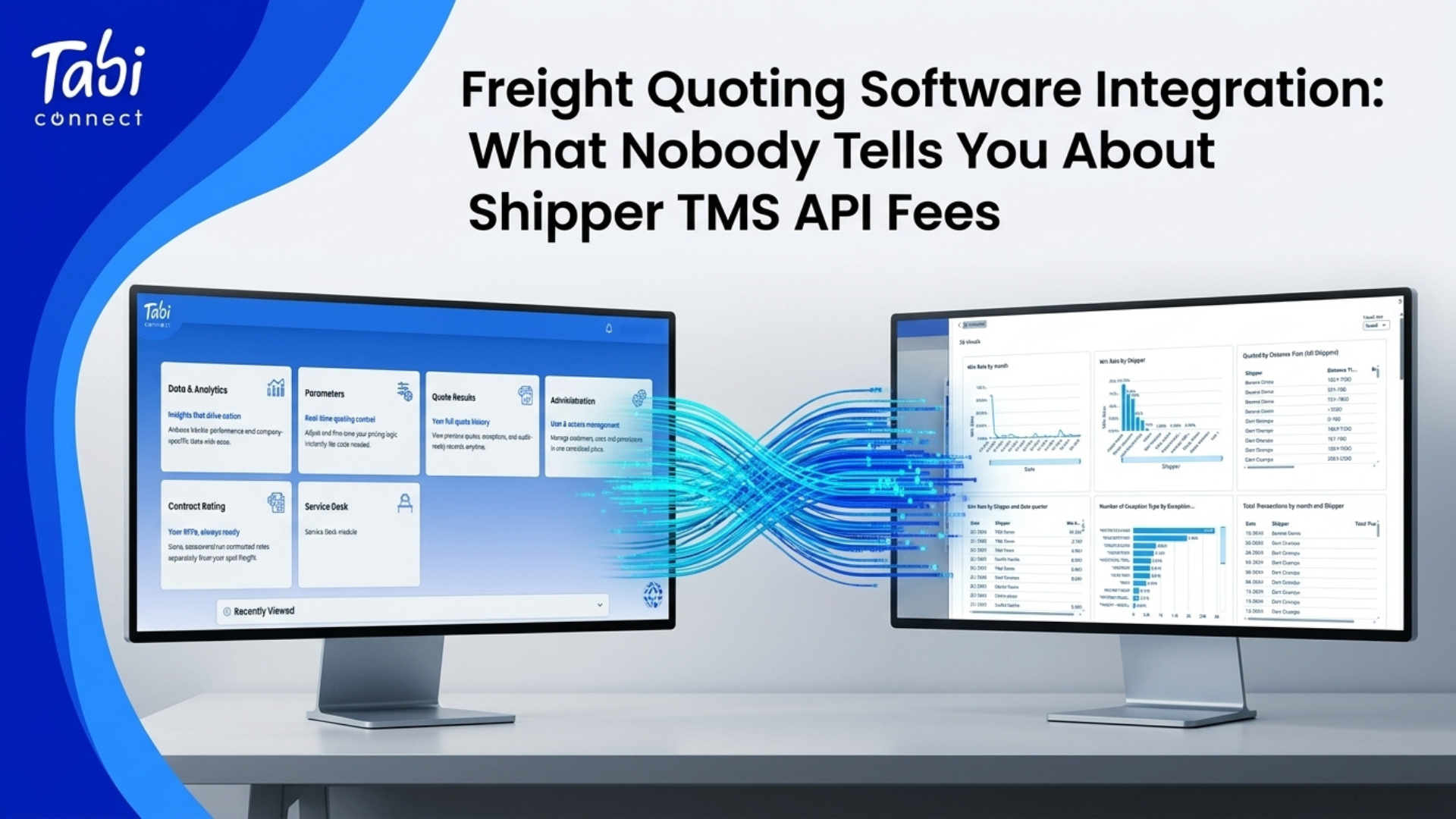
Most conversations about freight quoting software integration focus on speed: API versus RPA, how fast a connection returns a rate, how long onboarding takes. What gets left out is cost, specifically a cost that shows up on the shipper’s side of the connection, not the vendor’s. A number of major shipper TMS platforms, including E2open and Blue Yonder, charge a fee for third-party API access. That fee exists whether your quoting vendor absorbs it, negotiates it down, or quietly passes it straight through to you as an integration surcharge. Most brokers never ask which one is happening.
Why Shipper TMS Platforms Charge for API Access
A shipper’s TMS is built primarily to run their own operation, not to serve as free infrastructure for every broker who wants a live connection into it. Platforms like E2open and Blue Yonder have built out API access as its own line of business: a broker or their quoting vendor pays for a connection into the shipper’s system, on top of whatever the shipper themselves is paying to run the platform.
That’s a legitimate cost of doing business for the platform. It becomes a problem for a brokerage when a quoting vendor treats it as a pass-through cost by default, folding it into your integration fee without ever telling you it’s a separate line item that varies by shipper platform, not something intrinsic to the connection itself.
The Question Most Brokers Never Ask a Vendor
When you’re evaluating a quoting software vendor, “does this connect to E2open” or “does this connect to Blue Yonder” is the wrong first question. The right one is: who is paying the API access fee on that connection, and is it built into my subscription or billed to me separately as a pass-through.
This matters more than it looks like it should, because API access fees are not trivial and they scale with the number of shipper platforms you connect to. A brokerage running API connections to a dozen major shipper TMS platforms that each charge separately for access can end up paying for the same kind of connectivity multiple times over, once to the vendor for the integration work and again, indirectly, for every shipper platform’s access fee the vendor passes through.
A vendor with enough integration volume across its customer base has real leverage to negotiate these fees down, the same way any company with scale negotiates better terms than a single customer could get alone. Whether a vendor actually does that negotiating, or just quotes you the sticker price plus their margin on top, is one of the clearest signals of whether they’re building genuine infrastructure or reselling someone else’s.
What to Ask a Vendor About Connectivity Costs
A few direct questions surface the answer faster than reading a features page:
Do you have existing API relationships with major shipper TMS platforms like E2open and Blue Yonder, or would this be a new connection built from scratch for us? A vendor with established relationships has already done the negotiating that a first-time build hasn’t.
Is the shipper platform’s API access fee included in our subscription, or billed separately? Ask for this in writing, the same way you’d ask for implementation cost separate from the subscription fee.
If a new shipper platform we want to connect to charges for API access, do you negotiate that on our behalf, or pass along whatever they quote? This tells you whether the vendor is actively managing your connectivity costs or just facilitating them.
Where This Fits Alongside API, RPA, and EDI
The connection type still matters. API connections are fast and stable and don’t break when a shipper redesigns their portal. RPA mimics what a rep would do on screen and covers platforms without an API, at the cost of more maintenance. EDI still shows up in some legacy freight tech stacks. All of that is the mechanical side of integration, and it’s the side most vendor comparisons stop at.
The cost side is separate and usually invisible until a brokerage is well into a contract. A vendor quoting a lower base subscription can end up costing more once you’re connected to several fee-charging shipper platforms and paying the pass-through on each one, the same way a quote that looks cheaper can hide per-integration fees that weren’t in the base price. Connectivity cost belongs in the same conversation as implementation cost and the year-two tier upgrade: a number that’s easy to miss upfront and expensive to discover later.
Frequently Asked Questions
- Do all shipper TMS platforms charge for API access?
No. Some are open with their API and don’t charge third parties to connect. Others, including major platforms like E2open and Blue Yonder, do charge for third-party access. It varies by platform, which is exactly why it’s worth asking about connection by connection rather than assuming one answer covers every shipper you work with.
- How do I know if my current quoting vendor is passing these fees through to me?
Ask directly, and ask for it in writing, itemized separately from your subscription and implementation cost. If a vendor can’t or won’t separate the number, that’s usually because it’s baked into your rate in a way they’d rather not make visible.
- Does a vendor with more customers actually get better API pricing from shipper platforms?
Generally yes, the same way any vendor with scale has more leverage in a negotiation than a single brokerage would on its own. That leverage only benefits you if the vendor uses it on your behalf rather than pricing to their own margin regardless of what they’re paying underneath.
- Is this worth asking about before signing, or can it wait until after implementation?
Before signing. Once you’re live on a connection, switching or renegotiating costs time and disruption you’re better off avoiding. This belongs in the same RFP conversation as implementation cost and tier pricing, not something you discover on an invoice.
Ready to see what your actual connectivity cost looks like against your specific shipper mix, including platforms like E2open and Blue Yonder? Book a demo with a Tabi Connect Rate Tech Expert and bring your shipper list.