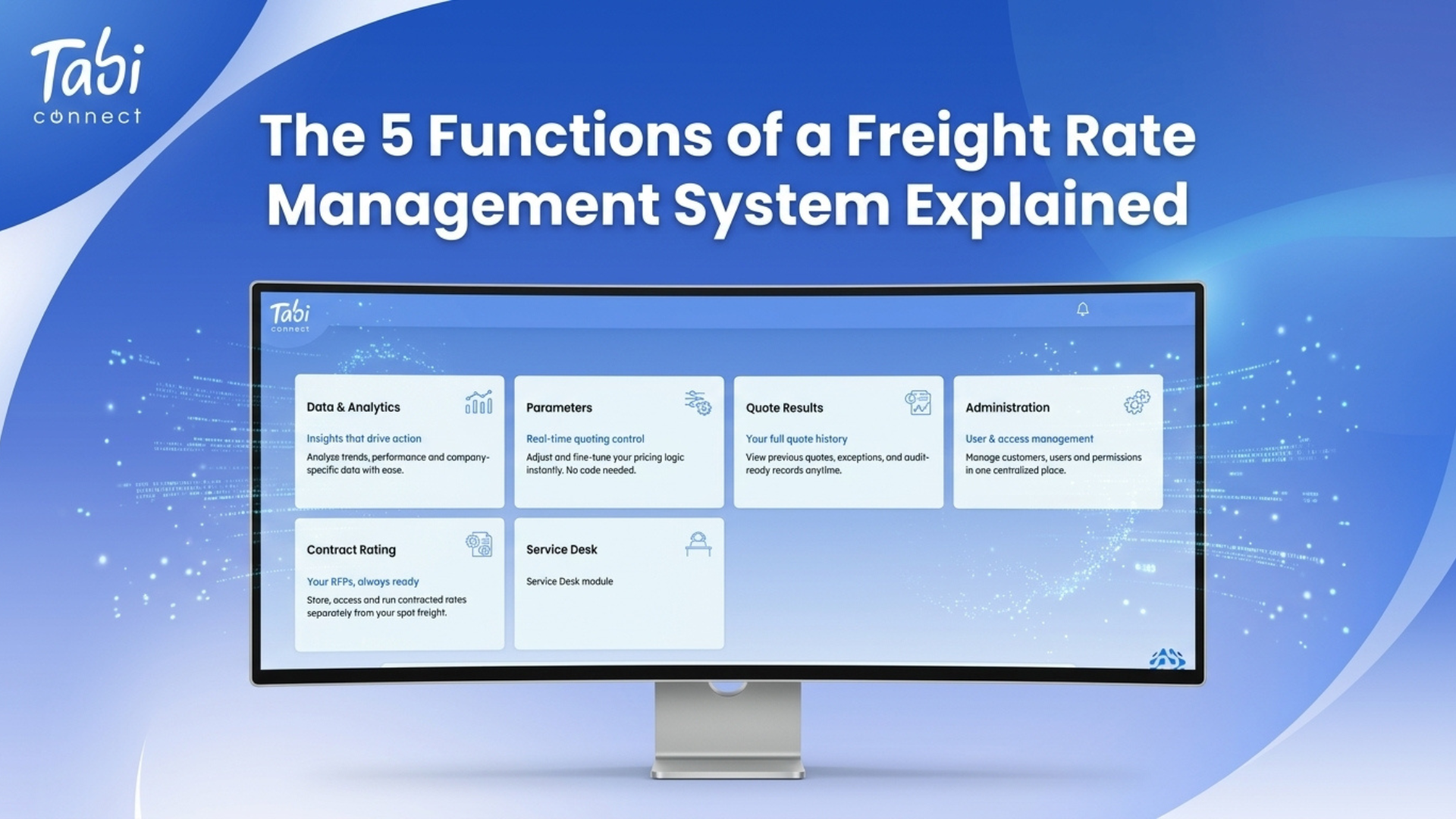
A freight rate management system is not a single feature. It’s a set of connected functions that, together, replace the manual quoting process for freight brokers. Understanding each function matters because brokerages often evaluate RMS platforms based on integration count or UI, when the more important question is whether the system actually covers all five of these areas. A gap in any one of them creates a bottleneck that undermines the others.
Function 1: Multi-Channel Request Capture
The first function is capturing rate requests from wherever they originate. For most freight brokers, that means shipper TMS platforms, load boards, and email. Some shippers submit requests through an API. Others use proprietary portals. Some still send free-form emails with load details buried in the message body.
A freight rate management system connects to each of these channels without requiring reps to log in, retrieve requests, and manually enter data. For shipper platforms that support direct API connections, the integration runs in the background in real time. For platforms that don’t support API, robotic process automation (RPA) handles the retrieval, mimicking the steps a human rep would take without the manual overhead.
This function is what enables volume. Without it, every rate request still lands in a rep’s queue, and the system is just a faster calculator rather than a true automation layer.
Function 2: Broker-Defined Pricing Logic
The second function is applying pricing logic that the broker controls. This is where the RMS enforces the brokerage’s strategy on every quote: which markup to target on which lanes, how to handle accessorials, which equipment types to accept, and what to do when market rates fall outside normal ranges.
The distinction between a well-built pricing logic engine and a basic rate lookup is the number of parameters it can handle simultaneously. A rate lookup retrieves a market rate. A pricing logic engine applies 40 to 50 parameters, across lane, carrier network, markup targets, and accessorials, and produces a quote that reflects the broker’s actual business rules.
In a manual quoting operation, this logic lives inside the heads of the most experienced reps. It’s valuable and difficult to replicate consistently. An RMS externalizes that logic into a rules-based system that applies it the same way every time, across every rep, every channel, and every time zone.
Function 3: Automated Quote Submission
The third function is returning the quote to the shipper without rep involvement. For API-connected shipper platforms, this can happen in under two seconds. For RPA-handled platforms, it takes slightly longer but still operates within a window that keeps the brokerage competitive.
Response time has a direct effect on whether a quote wins. When a shipper submits a request to multiple brokers simultaneously, the first credible quote often sets the anchor for the conversation. Quotes that arrive late enter a pricing discussion that has already been framed by a competitor.
Automated submission removes the rep from the critical path for routine quotes. Reps still handle exceptions, manage relationships, and work on accounts that require real analysis. The automation layer handles the volume that would otherwise fill their queues and slow the operation down.
Function 4: Exception Management
The fourth function is handling requests that fall outside the defined pricing parameters. Not every rate request fits the rules a broker has configured. A load with unusual dimensions, a lane outside the carrier network’s coverage area, or a request that triggers a markup threshold the broker has set as a floor, these need human review.
A freight rate management system identifies those requests automatically, flags them as exceptions, and routes them to the appropriate rep or team. This is how a brokerage maintains quality control at scale without manually reviewing every quote.
Over time, exception handling also generates useful data. If the same type of request is consistently flagged as an exception, that signals a gap in the pricing logic or the carrier network.
Function 5: Full Quoting Analytics
The fifth function is capturing and analyzing 100% of the quoting activity, including requests that did not result in a quote. This is where the RMS closes the feedback loop.
Most manual quoting operations have fragmented data. Some quotes happen in email threads, others in TMS workflows, and others through portal interfaces that don’t export clean data. The result is that operations leadership can’t answer basic questions: How many rate requests did we receive this week? Where are we winning versus losing? Which lanes are consistently coming in below our markup floor?
A freight rate management system captures all of this in a unified data layer. Dashboards track quote volume, win and loss rates, response times, expected markup, and shipper network performance across dozens of data points. That data drives better pricing decisions and makes the entire operation easier to manage.
Frequently Asked Questions About Freight Rate Management System Functions
What is the most important function of a freight rate management system? All five functions are interdependent, but multi-channel request capture is the foundation. If the system isn’t connected to every channel where requests arrive, the other functions only apply to a subset of the business.
Can a freight rate management system work without all five functions? A platform missing one of these functions will create a gap that the quoting operation has to fill manually. Exception management is often the first to be underbuilt in lighter-weight tools, leading to unanswered requests and missed loads.
How does an RMS handle shipper platforms that don’t support API connections? RPA fills the gap. It mimics human interactions with the shipper portal, retrieving and submitting data without requiring a native API. Tabi Connect uses both API and RPA depending on the shipper’s technology. See how the technology works.
Does an RMS require coding to update pricing logic? No. A well-built RMS uses a no-code interface for pricing logic configuration. Tabi Connect allows parameter updates from any web browser in real time, with no IT involvement required.
What analytics does a freight rate management system provide? Standard analytics in a freight RMS include quote volume, win and loss rates, response time by channel, expected markup by lane, exception rates, and shipper network performance. Tabi Connect tracks over 48 data points per quote.
See All Five Functions in Action
Tabi Connect covers all five core functions of a freight rate management system: multi-channel capture, broker-defined pricing logic, automated submission, exception handling, and full quoting analytics.
Speak with a Rate Tech Expert now!