Freight brokers often ask whether they need a rate management system if they already have a TMS. A TMS manages what happens after a load is awarded. A rate management system manages what happens before it: whether you respond, how quickly, at what price, and what happens to every quote that doesn’t win. That last part is where most brokerages have a blind spot they don’t know about.
What a TMS Does
A Transportation Management System is built for load execution. It’s where brokers manage the carrier relationship, tender the load, track the shipment, handle documentation, and process invoicing. Most TMS platforms also provide reporting on load activity, carrier performance, and operational efficiency.
For a freight brokerage, a TMS is not optional. It’s the operational backbone. Everything that happens after a shipper awards a load runs through it.
What a TMS is not built for is the quoting process that precedes the award. Most TMS platforms include some quoting functionality, typically a rate lookup and a way to submit a number. That functionality is designed for occasional use, not for a brokerage quoting hundreds of loads per day across 40 shipper platforms with different pricing rules for different lanes and customers. And because the TMS is built around loads, not requests, it typically only sees a quote once it’s already won and became a load. Everything that happened before that, every rate a rep sent that didn’t get awarded, never enters the system at all.
The Data Gap Most Brokerages Don’t Know They Have
Here’s the practical result of quoting through a TMS or a manual process: a brokerage can tell you exactly what it moved, at what rate, on what lane. It usually cannot tell you what it quoted and lost. Those two numbers are not the same thing, and the gap between them is where a lot of a brokerage’s actual pricing intelligence is sitting unused.
A TMS captures realized margin, the number that shows up once a load is booked and executed. A rate management system captures quoted markup on every request that comes through, whether the shipper awarded it or not. That distinction matters because a brokerage that only sees its wins is only seeing half its pricing story. If you’re losing 60% of the loads you quote on a specific lane, that’s not visible in a system that never recorded the losses in the first place. You just see a lane with lower volume than it should have, with no way to tell whether that’s a capacity problem, a pricing problem, or a speed problem.
This is the actual argument for treating an RMS as more than a convenience layer. It’s the only place in the tech stack where a brokerage’s full quoting activity, won and lost, lives in one system with consistent data behind it.
What a Rate Management System Does
A rate management system is built for the front end of the freight transaction: capturing the rate request, applying pricing logic, and returning a quote. It’s designed for volume, speed, and consistency.
Where a TMS handles one load at a time in an execution workflow, an RMS processes many rate requests simultaneously, automatically, and without rep involvement for routine quotes. The core capabilities:
Multi-channel request capture. Rate requests come in through shipper TMS platforms, load boards, and email. An RMS connects to each of those sources using API connections where available and RPA where not, so no request goes untracked.
Broker-defined pricing logic. The rules that govern what markup to quote on which lanes, with which accessorials, are defined once and applied consistently to every quote. Changes can be made from any web browser in real time.
Automated submission. Quotes go back to shippers automatically, in some cases in under two seconds, without a rep in the loop.
Exception routing. Requests that fall outside the defined parameters are flagged and sent for manual review rather than going unanswered.
Full quoting analytics. Every rate request is captured, whether it resulted in a quote or not, giving operations a complete view of quoting performance, including everything a TMS-only shop never sees.
Where the Confusion Comes From
The overlap in terminology creates most of the confusion. TMS vendors often describe their software as handling rate management, meaning they store contracted rates and use them for tendering decisions. That’s a different function than a freight broker’s spot quoting operation, and it’s also a different data problem than the one described above: contracted rate storage isn’t the same as capturing every spot quote a brokerage sends out.
When a shipper submits a request through their portal and expects a response in under a minute, the TMS quoting module isn’t the right tool. It’s not designed for that response time, and it doesn’t support the kind of pricing logic complexity that a high-volume brokerage needs: lane-level markup targets, dynamic adjustments based on market conditions, carrier network constraints, and accessorial handling across hundreds of shippers.
How the Two Systems Work Together
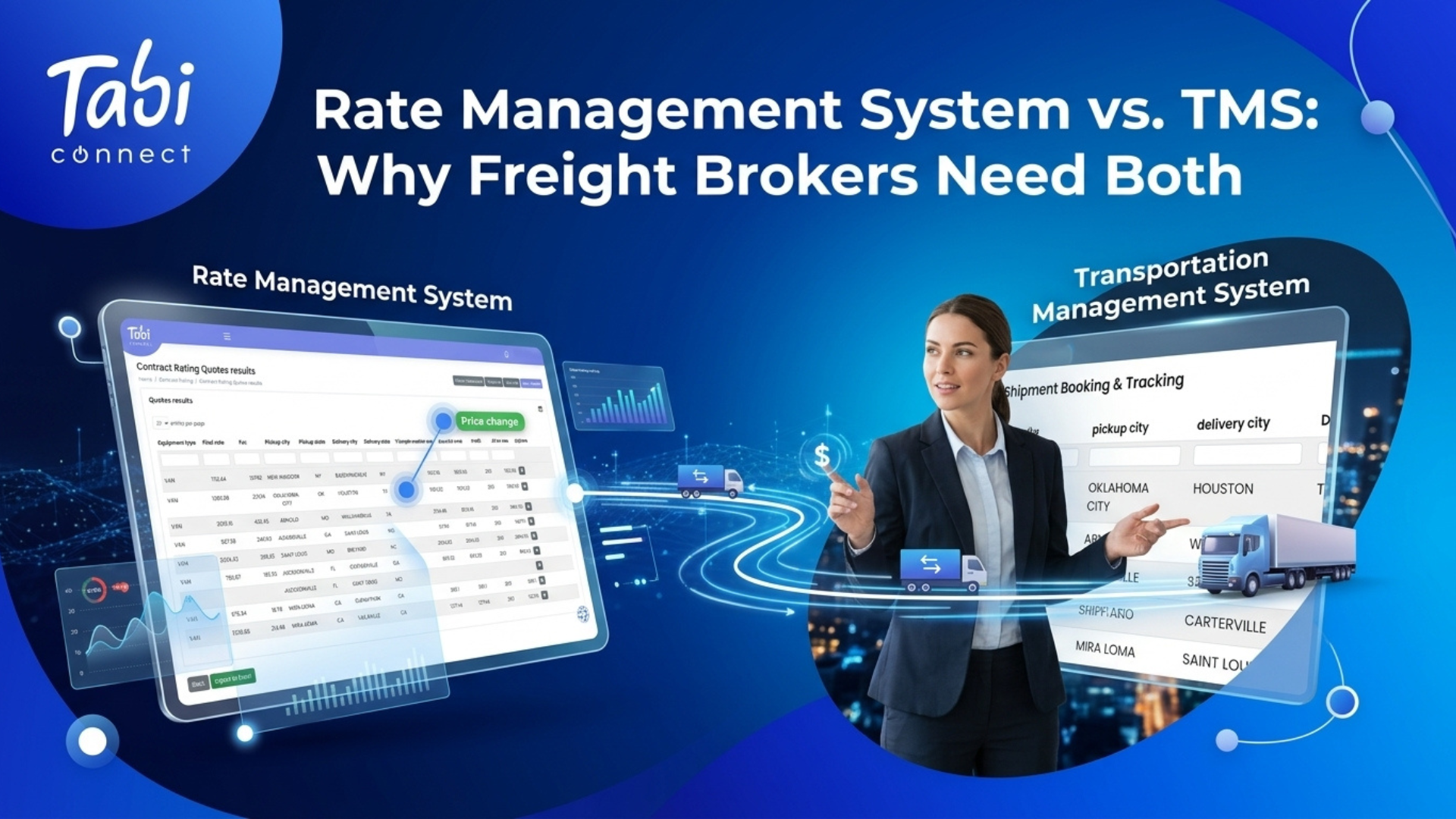
An RMS and a TMS are complementary. In a well-structured brokerage technology stack, they divide the workflow cleanly.
The RMS handles everything up to the award: capturing the request, pricing it, submitting the quote, tracking the win or loss, and feeding analytics back to operations.
The TMS handles everything after the award: tendering to a carrier, tracking the load, managing documentation, and processing the invoice.
Data flows between the two. When a shipper awards a load, the RMS passes load details to the TMS so execution can begin without manual re-entry. The TMS passes carrier and lane data back to the RMS to inform future pricing decisions. Tabi Connect integrates with major TMS platforms directly, so brokers don’t have to choose between their existing execution system and a purpose-built quoting layer.
Why More Sophisticated Brokerages Build a Pricing Function Around This
The brokerages that have solved this data gap tend to look structurally different from the ones that haven’t. Once quoted markup, win rate, and loss reasons are all captured in one place instead of scattered across email threads and a TMS that only sees wins, pricing stops being something a senior rep does from memory and starts being something a team manages with actual data behind it. That’s why the more sophisticated brokerages in this space have built out dedicated pricing and markup analytics functions: not because it’s a trend, but because they treat pricing as a strategy with its own inputs and outputs, and an RMS is what makes that strategy manageable instead of anecdotal.
A brokerage without full quoting data can tell you what won. A brokerage with it can tell you why, and can act on the lanes, shippers, and reps where the gap between quoted and won is telling them something they’d otherwise never see.
When Brokerages Run Into Trouble
Most quoting problems in freight brokerages trace back to trying to solve an RMS problem with a TMS or with manual processes. The signs: reps spending hours each day retrieving rate requests from shipper portals, quotes going out 20 or 30 minutes after the request was submitted, different reps quoting similar lanes at different markups, no visibility into how many requests went unanswered, and no record at all of what was quoted and lost.
These aren’t TMS problems, and a TMS upgrade won’t fix them. They’re quoting workflow and quoting data problems, and the right solution is a platform designed specifically for that workflow. Learn more in our Margin Protection Guide.
The Business Case for Using Both
For brokerages at volume, the difference is measurable. One brokerage using Tabi Connect increased load count by 570% in six months without adding headcount, a result that isn’t possible through a TMS quoting module or manual processes, because neither is built to maintain that response rate across that volume, and neither would have surfaced the pricing pattern that made it possible to get there.
Common Questions About Rate Management Systems vs. TMS
Can a TMS replace a rate management system? No. A TMS is built for load execution after the award. It’s not designed to handle high-volume spot quoting across multiple shipper platforms with complex, broker-defined pricing logic, and it typically never records the quotes that didn’t win.
Does an RMS replace a TMS? No. A rate management system handles the quoting workflow before the load is awarded. It doesn’t manage carrier tendering, load tracking, documentation, or invoicing. Brokerages need both systems operating in their respective parts of the workflow.
Do these systems need to integrate with each other? Yes, for an efficient operation. When a load is awarded, load details should pass from the RMS to the TMS automatically to avoid manual re-entry. Tabi Connect integrates with major TMS platforms to support this handoff.
What TMS platforms does Tabi Connect work with? Tabi Connect integrates with major TMS platforms used by freight brokers. Speak with a Rate Tech Expert to confirm compatibility with your specific setup.
How do I know if we need an RMS? If your team is spending significant time manually retrieving and entering rate requests, quotes are going out more than a few minutes after the request arrives, or you have no visibility into win rates and the quotes you lost, those are indicators that a quoting-specific platform would address a real operational gap.
See How Tabi Connect Works Alongside Your TMS
Tabi Connect is a rate management system built for freight brokers. It handles the full quoting workflow, integrates with major TMS platforms, and connects to 70+ shipper systems using API and RPA.
Speak with a Rate Tech Expert now!